 BlackScreen.live
Samsung Odyssey Series Review
Samsung is the world's largest display panel manufacturer, and the Odyssey lineup showcases their panel technology across multiple tiers. From the budget Odyssey G5 to the premium Odyssey OLED G8, Samsung offers gaming monitors at every price point with a focus on contrast and immersion.
1. VA Panel Characteristics (G5, G7)
Samsung's VA panels offer the highest contrast ratios in the gaming monitor market—typically 3000:1 to 6000:1 compared to 1000:1 for IPS. This makes dark scenes in games look dramatically better. However, VA panels have a well-documented weakness: black smearing.
Black smearing occurs when dark pixels transition slowly, leaving a visible trail behind fast-moving dark objects. In our testing of the Odyssey G7, we measured 12ms GTG for dark-to-dark transitions—significantly slower than the advertised "1ms." This is most noticeable in games with dark environments and fast camera movement.
Samsung has improved VA response times in recent generations, but black smearing remains a characteristic of VA technology that buyers should evaluate before purchasing.
2. Neo QLED (G8 Neo, G9 Neo)
Samsung's Neo QLED monitors use Mini-LED backlights with hundreds to thousands of local dimming zones. The Odyssey Neo G8 features 2048 local dimming zones, delivering near-OLED contrast with LCD brightness advantages. Peak brightness reaches 2000 nits—significantly higher than OLED.
In our testing, the Neo G8 achieved 1,200:1 effective contrast in real-world content (accounting for blooming around bright objects). This is dramatically better than standard IPS but still below OLED's infinite contrast.
3. OLED (G8 OLED, G9 OLED)
Samsung's OLED gaming monitors use QD-OLED (Quantum Dot OLED) technology, which combines OLED's self-emissive pixels with quantum dot color enhancement. This delivers wider color gamut than LG's WOLED panels (99% DCI-P3 vs 98%) and higher peak brightness.
QD-OLED burn-in risk is similar to WOLED. Samsung includes a pixel refresh feature and recommends enabling screen savers for inactivity periods.
4. Warranty Policy
Samsung's dead pixel policy follows ISO 9241-307 Class II (2 bright pixels allowed). This is adequate but not as strong as Dell's zero-pixel guarantee. Samsung's support quality varies by region—US support is generally responsive, while some international markets report longer resolution times.
5. Testing Your Samsung Odyssey
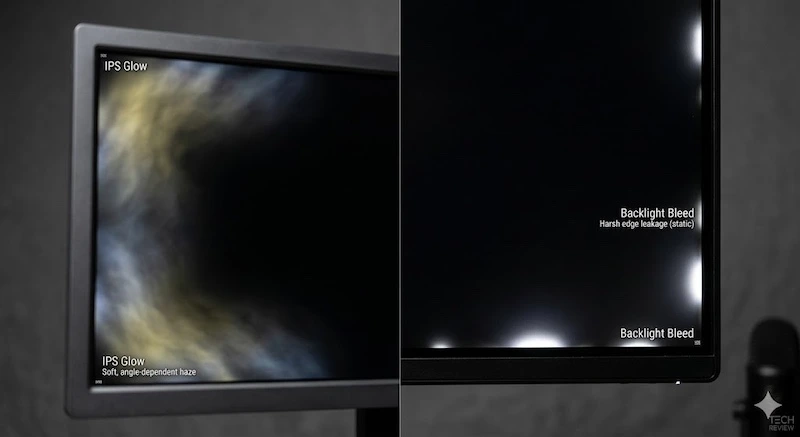
- Black Screen Test — evaluate VA contrast and check for backlight bleed
- Display Test — check color accuracy and gray uniformity
- Monitor Test — complete diagnostic protocol